

Despite its prevalence in nature, phenotypic plasticity is generally excluded from ecological and/or evolutionary models. This exclusion can be partly attributed to the nature of phenotypic plasticity, since its abundance is matched by a staggering diversity in the various forms it can take, for example, reversible versus irreversible or continuous versus discrete.
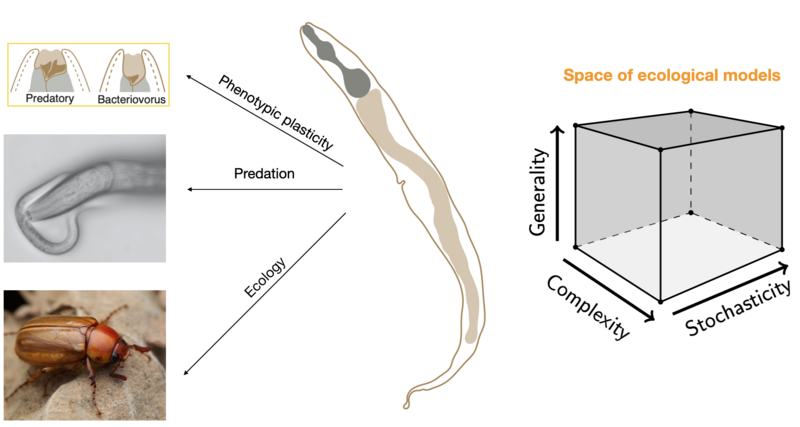
In order to develop theory to understand the ecological and evolutionary implications of phenotypic plasticity, instead of taking advantage of existing models, we use Pristiounchus pacificus - an established model organism - as a starting point to develop a range of models inspired by it. The models that have been developed in this context reflect an exploration of the space of the possible models with respect to their generality, complexity, and stochasticity. Below, two main lines of our research are highlighted:
I) Computational reconstruction of communities
Nematodes of genus Pristiounchus and their relatives are found in association with Scarab beetles. It is assumed that dauer larvae disperse in the environment and hitchhike on beetles. Following the natural death of the beetle, dauer larvae develop into adults and compete over resources, and as these resources deplete, new dauer larvae develop and disperse into the surrounding. This cycle of colonization, competition, and dispersal provides a fascinating setting to ask foundational questions about the role of phenotypic plasticity in each step of this cycle, its importance in affecting the process of species succession and community assembly on the beetle, as well as broader questions concerning coexistence at the community and metacommunity levels.
In order to understand this process, we observe the succession of nematodes on beetles sampled from our field station on La Réunion island. Subsequently, we measure traits of interest, including mouth-form plasticity, in the lab for nematodes emerging in these communities. A crucial aspect in these measurements is the preservation of variation in the data, achieved by employing Bayesian models, in order to better understand the role of intraspecific variation. The laboratory measurements are combined with sophisticated agent-based models to illustrate the potential ecological dynamics that could unfold in such communities.
II) In search of an Übermodel
In the context of metacommunity ecology, the notion of an ubermodel refers to a framework that integrates the foundational processes that shape communities. The many aspects of community and metacommunity ecology that can be explored in Pristiounchus prompted us to use insights gained from this plasticity model organism to construct models that enable asking general questions about coexistence. For example, we have developed a graph-based model, inspired by evolutionary graph theory, as a step in our ambitious attempt to provide methods that can supplement existing theoretical framework and, importantly, to highlight the importance of phenotypic plasticity in understanding community and metacommunity dynamics.
Kalirad, A. & Sommer, R. J. (2025): Ecological graph theory: a framework to simulate ecological competition on a graph. Methods in Ecology and Evolution, 16, 2667–2680. https://doi.org/10.1111/2041-210X.70121
Kalirad, A. & Sommer, R. J. (2024): The role of plasticity and stochasticity in coexistence. Ecology Letters, 27, e14370.
Kalirad, A. & Sommer, R. J. (2024): Spatial and temporal heterogeneity alters the cost of plasticity in Pristionchus pacificus. PLoS Computational Biology, 20, e1011823.